Digital Logic

Community
Digital Logic
2077 Boards
Section A
Answer any two questions.
1
Design a combinational circuit that generates 9’s complement of a BCD number.
10
Connect with us on Discord to become a contributor.
2
Implement the following functions using PLA
w (A, B, C, D) = Σ(2, 12, 13)
x (A, B, C, D) = Σ(7, 8, 9, 10, 11, 12, 13, 14, 15)
y (A, B, C, D) = Σ(0, 2, 3, 4, 5, 6, 7, 8, 9, 10, 11, 15)
z (A, B, C, D) = Σ(1, 2, 8, 12, 13)
10
Connect with us on Discord to become a contributor.
3
Design sequential circuit specified by the following state diagram using T flip-flops.
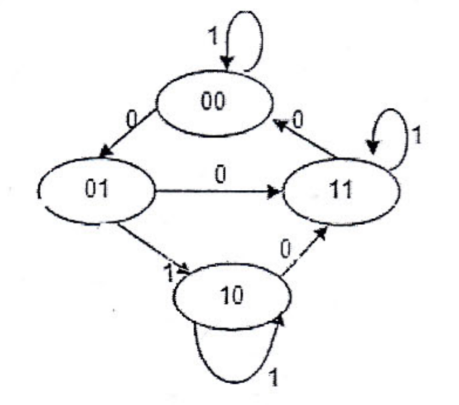
10
Connect with us on Discord to become a contributor.
Section B
Answer any eight questions.
4
List two major characteristics of digital computer. Represent -6 (negative six) 8 bits in signed magnitude, signed 1’s complement and signed 2’s complement respectively. Represent decimal number 4673 in a) octal and b) BCD
5
Characteristics of Digital Computer
- Speed: Digital computers can perform complex calculations and operations at extremely high speeds, processing millions or billions of instructions per second.
- Accuracy: They are designed to deliver precise results without errors, provided the input data and programs are correct.
Representation of -6 (8 bits)
-
Signed Magnitude:
- Positive 6 in 8-bit binary: 0000 0110
- For -6, the most significant bit (MSB) is set to 1 (for negative), and the remaining bits represent the magnitude.
- Representation: 1000 0110
-
Signed 1’s Complement:
- Positive 6 in 8-bit binary: 0000 0110
- To get the 1’s complement of -6, invert all bits of the positive 6 representation.
- Representation: 1111 1001
-
Signed 2’s Complement:
- Positive 6 in 8-bit binary: 0000 0110
- To get the 2’s complement of -6, take the 1’s complement and add 1.
- 1’s Complement of 6: 1111 1001
- Add 1: 1111 1001 + 1 = 1111 1010
- Representation: 1111 1010
Representation of Decimal Number 4673
a) Octal:
* Divide the decimal number by 8 and record the remainders.
* 4673 ÷ 8 = 584 remainder 1
* 584 ÷ 8 = 73 remainder 0
* 73 ÷ 8 = 9 remainder 1
* 9 ÷ 8 = 1 remainder 1
* 1 ÷ 8 = 0 remainder 1
* Reading the remainders from bottom to top gives the octal representation.
* Representation: 11101 (octal)
b) BCD (Binary-Coded Decimal):
* Each decimal digit is represented by its 4-bit binary equivalent.
* Decimal: 4 6 7 3
* BCD: 0100 0110 0111 0011
* Representation: 0100 0110 0111 0011
5
Where is CMOS suitable to use? Define Power dissipation. Show that the positive logic NAND gate is a negative logic NOR gate and vice versa.
5
Connect with us on Discord to become a contributor.
6
Simplify the following function and implement them with two level NOR gate circuit, F(w, x, y, z) = wx’ + y’z’ + w’yz’.
5
Connect with us on Discord to become a contributor.
7
Design a full subtractor circuit with three inputs x, y, (B_{in}) and two outputs Diff and (B_{out})· The circuit subtracts (x-y-B_{in})., where (B_{in}) is the input borrow, (B_{out}) is the output borrow, and Diff is the difference.
5
Connect with us on Discord to become a contributor.
8
Design 4-bit even parity generator.
5
Connect with us on Discord to become a contributor.
9
What is the difference between a serial and parallel transfer? Explain how to convert serial data to parallel and parallel data to serial. What type of register is needed?
5
-
Difference between Serial and Parallel Transfer
- Serial Transfer: Data bits are transmitted one after another over a single communication channel.
- Advantages: Requires fewer transmission lines, suitable for long-distance communication, lower cost.
- Disadvantages: Slower speed due to sequential bit transmission.
- Parallel Transfer: Multiple data bits are transmitted simultaneously over multiple dedicated communication channels (one for each bit).
- Advantages: Higher speed due to concurrent bit transmission.
- Disadvantages: Requires more transmission lines, typically used for short-distance communication, higher cost and complexity.
- Serial Transfer: Data bits are transmitted one after another over a single communication channel.
-
Data Conversion
- Serial to Parallel Conversion: Serial data bits are received one by one over a single input line. These bits are shifted into a register sequentially. Once the required number of bits (e.g., a byte) has been accumulated in the register, they can be read out simultaneously on multiple output lines.
- Parallel to Serial Conversion: Parallel data bits are loaded simultaneously into a register using multiple input lines. These bits are then shifted out of the register one bit at a time, sequentially, onto a single output line.
-
Type of Register Needed
A shift register is required for both serial-to-parallel and parallel-to-serial data conversion. Specifically:- A Serial-In, Parallel-Out (SIPO) shift register is used for serial-to-parallel conversion.
- A Parallel-In, Serial-Out (PISO) shift register is used for parallel-to-serial conversion.
10
Explain negative-edge triggered D flip flop with necessary logic diagram and truth table.
5
Connect with us on Discord to become a contributor.
11
Illustrate the use of Binary ripple counter and BCD ripple counter.
5
Binary Ripple Counter
- An asynchronous counter where the clock input for each successive flip-flop is derived from the output of the preceding flip-flop.
- Counts in a straightforward natural binary sequence (e.g., a 3-bit ripple counter counts from 000 to 111).
- The term "ripple" describes the way the output change propagates or "ripples" through the stages due to inherent propagation delays of the flip-flops.
- Often implemented using J-K or T flip-flops configured to toggle (J=K=1 or T=1).
- Used for basic event counting and frequency division.
BCD Ripple Counter (Decade Counter)
- A specialized asynchronous counter designed to count from 0 (0000) to 9 (1001) and then reset back to 0.
- It is essentially a 4-bit ripple counter with additional feedback logic to skip the binary states 1010 through 1111.
- Typically, a NAND gate detects the count of 10 (binary 1010, corresponding to Q3=1 and Q1=1) and its output is used to clear all flip-flops, forcing the counter to reset.
- This counter produces a BCD (Binary-Coded Decimal) output, making it highly useful in digital systems requiring decimal counting and display.
- Applications include digital clocks, frequency meters, and driving 7-segment displays.
12
Write Short notes on (Any two)
RTL
State Reduction
POS
5
RTL (Register Transfer Level)
- RTL is an abstraction level used in digital circuit design to describe the flow of data between hardware registers and the logical operations performed on that data.
- It focuses on how data is transferred between registers and what operations (e.g., arithmetic, logical, shift) are executed on the data held within them.
- RTL descriptions are typically written using Hardware Description Languages (HDLs) such as Verilog or VHDL.
- This level of abstraction facilitates the design and verification of complex digital systems by allowing designers to focus on functionality rather than low-level gate implementations.
- Key elements at the RTL include registers, multiplexers, adders, ALUs, and the control logic that orchestrates data movement and operations.
State Reduction
- State reduction is a process in the design of sequential circuits, particularly finite state machines (FSMs), aimed at minimizing the number of states required to implement a given state table or state diagram.
- The primary goal is to reduce the overall complexity of the circuit, which leads to a decrease in the number of flip-flops required and simplification of the associated combinational logic.
- Two states are considered equivalent if, for every possible input sequence, they produce the same output sequence and transition to equivalent next states.
- Techniques for state reduction include the implication table method or partitioning methods, which systematically identify and merge equivalent or redundant states.
- Successful state reduction results in a more efficient, cost-effective, and potentially faster hardware implementation without altering the specified sequential behavior of the system.