Digital Logic

Community
Digital Logic
2075 Boards
Section A
Answer any two questions.
1
Implement the following function F = Σ(1, 2, 3, 4, 8) using
Decoder
Multiplexer
PLA
10
Connect with us on Discord to become a contributor.
2
Design clocked sequential circuit of the following state diagram by using JK flip-flop
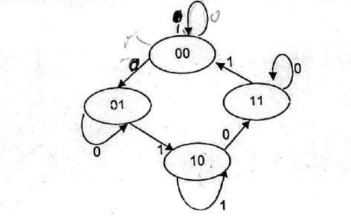
10
Connect with us on Discord to become a contributor.
3
The following is a truth table of a 3-input,4 output combinational circuit. Tabulate the PAL programming table for the circuit and mark for the circuit and mark the fuses to be blown in a PAL diagram.
| X | Y | Z | A | B | C | D |
|---|---|---|---|---|---|---|
| 0 | 0 | 0 | 0 | 0 | 0 | 0 |
| 0 | 0 | 1 | 1 | 1 | 1 | 1 |
| 0 | 1 | 0 | 1 | 0 | 1 | 1 |
| 0 | 1 | 1 | 0 | 1 | 0 | 1 |
| 1 | 0 | 0 | 1 | 0 | 1 | 0 |
| 1 | 0 | 1 | 0 | 0 | 0 | 1 |
| 1 | 1 | 0 | 1 | 1 | 1 | 0 |
| 1 | 1 | 1 | 0 | 1 | 1 | 1 |
Here X, Y, Z are input and A, B, C, D are output
10
Connect with us on Discord to become a contributor.
Section B
Answer any eight questions.
4
Convert the following decimal numbers to the indicated bases.
7562.45 to octal
1938.257 to hexadecimal
175.175 to binary
5
Decimal to Octal (7562.45 to octal)
-
Integer Part (7562): Repeated division by 8
- $7562 \div 8 = 945$ remainder $2$
- $945 \div 8 = 118$ remainder $1$
- $118 \div 8 = 14$ remainder $6$
- $14 \div 8 = 1$ remainder $6$
- $1 \div 8 = 0$ remainder $1$
- Reading remainders upwards: $16612_8$
-
Fractional Part (0.45): Repeated multiplication by 8
- $0.45 \times 8 = 3.60 \implies 3$
- $0.60 \times 8 = 4.80 \implies 4$
- $0.80 \times 8 = 6.40 \implies 6$
- $0.40 \times 8 = 3.20 \implies 3$
- Reading integers downwards: $.3463..._8$
-
Combined: $7562.45_{10} \approx 16612.3463_8$
Decimal to Hexadecimal (1938.257 to hexadecimal)
-
Integer Part (1938): Repeated division by 16
- $1938 \div 16 = 121$ remainder $2$
- $121 \div 16 = 7$ remainder $9$
- $7 \div 16 = 0$ remainder $7$
- Reading remainders upwards: $792_{16}$
-
Fractional Part (0.257): Repeated multiplication by 16
- $0.257 \times 16 = 4.112 \implies 4$
- $0.112 \times 16 = 1.792 \implies 1$
- $0.792 \times 16 = 12.672 \implies C$ (since $12_{10} = C_{16}$)
- $0.672 \times 16 = 10.752 \implies A$ (since $10_{10} = A_{16}$)
- Reading integers downwards: $.41CA..._{16}$
-
Combined: $1938.257_{10} \approx 792.41CA_{16}$
Decimal to Binary (175.175 to binary)
-
Integer Part (175): Repeated division by 2
- $175 \div 2 = 87$ remainder $1$
- $87 \div 2 = 43$ remainder $1$
- $43 \div 2 = 21$ remainder $1$
- $21 \div 2 = 10$ remainder $1$
- $10 \div 2 = 5$ remainder $0$
- $5 \div 2 = 2$ remainder $1$
- $2 \div 2 = 1$ remainder $0$
- $1 \div 2 = 0$ remainder $1$
- Reading remainders upwards: $10101111_2$
-
Fractional Part (0.175): Repeated multiplication by 2
- $0.175 \times 2 = 0.350 \implies 0$
- $0.350 \times 2 = 0.700 \implies 0$
- $0.700 \times 2 = 1.400 \implies 1$
- $0.400 \times 2 = 0.800 \implies 0$
- $0.800 \times 2 = 1.600 \implies 1$
- $0.600 \times 2 = 1.200 \implies 1$
- $0.200 \times 2 = 0.400 \implies 0$
- $0.400 \times 2 = 0.800 \implies 0$ (This sequence repeats)
- Reading integers downwards: $.00101100..._2$
-
Combined: $175.175_{10} \approx 10101111.00101100_2$
5
Express the Boolean Function F = A + B’ C in a sum of min terms .
5
To express the Boolean Function F = A + B'C in a sum of minterms:
-
Identify variables: The function involves three variables: A, B, C.
-
Expand each term to include all variables:
-
For the term A:
A = A(B + B') = AB + AB'
AB = AB(C + C') = ABC + ABC'
AB' = AB'(C + C') = AB'C + AB'C'
So, A = ABC + ABC' + AB'C + AB'C' -
For the term B'C:
B'C = B'C(A + A') = AB'C + A'B'C
-
-
Combine all expanded terms:
F = (ABC + ABC' + AB'C + AB'C') + (AB'C + A'B'C) -
Remove duplicate terms: The term AB'C appears twice.
F = ABC + ABC' + AB'C + AB'C' + A'B'C -
Convert to minterm notation: Assign binary values (A=1, B=1, C=1 for unprimed; A=0, B=0, C=0 for primed literals).
- ABC = 111₂ = m₇
- ABC' = 110₂ = m₆
- AB'C = 101₂ = m₅
- AB'C' = 100₂ = m₄
- A'B'C = 001₂ = m₁
-
Express as a sum of minterms:
F = m₁ + m₄ + m₅ + m₆ + m₇Alternatively, using summation notation:
F = Σ(1, 4, 5, 6, 7)
6
Reduce the following function using k-map F = B’D + A’BC’ + AB’C + ABC’
5
Connect with us on Discord to become a contributor.
7
Design a combinational circuit with three inputs, x, y, and z, and three outputs, A, B, and C. When the binary input is 0, 1, 2, or 3, the binary output is one greater than the input. When the binary input is 4, 5, 6, or 7, the binary output is one less than the input.
5
Connect with us on Discord to become a contributor.
8
Implement half adder using 2-4 decoder.
5
Connect with us on Discord to become a contributor.
9
What is the difference between a serial and parallel transfer? Explain how to convert serial data to parallel and parallel data to serial. What type of register is needed?
5
Difference between Serial and Parallel Transfer
- Serial Transfer:
- Transmits data one bit at a time over a single communication line.
- Slower speed due to sequential transmission.
- Requires fewer wires, making it suitable for long-distance communication and reducing cable cost.
- Example: USB, Ethernet.
- Parallel Transfer:
- Transmits multiple bits (e.g., 8, 16, 32 bits) simultaneously over multiple communication lines.
- Faster speed due to simultaneous transmission of an entire word or byte.
- Requires more wires, leading to higher cable cost and making it less suitable for long distances due to synchronization issues and crosstalk.
- Example: Internal computer buses, old printer ports (Centronics).
Converting Serial Data to Parallel Data
To convert serial data to parallel data, a Serial-In, Parallel-Out (SIPO) Shift Register is used. Data bits are fed into the shift register one bit at a time (serially) on consecutive clock pulses. After the desired number of bits (e.g., 8 bits for a byte) have been shifted into the register, all bits are available simultaneously at the parallel output lines of the register.
Converting Parallel Data to Serial Data
To convert parallel data to serial data, a Parallel-In, Serial-Out (PISO) Shift Register is used. The parallel data bits are loaded simultaneously into the shift register on a single clock pulse. Subsequent clock pulses then shift the data out of the register one bit at a time (serially) from the serial output line.
Type of Register Needed
The type of register needed for both conversions is a Shift Register. Specifically, a Serial-In, Parallel-Out (SIPO) shift register for serial-to-parallel conversion and a Parallel-In, Serial-Out (PISO) shift register for parallel-to-serial conversion.
10
Design 4-bit even parity generator.
5
Connect with us on Discord to become a contributor.
11
Design a 4-bit binary ripple counter with D flip-flops.
5
Connect with us on Discord to become a contributor.
12
Write short notes on any two:
SIMM
RTL
Parity Checker
5
SIMM
- Single In-line Memory Module.
- A type of RAM module used in older personal computers (e.g., 386, 486, early Pentium systems).
- Features a single row of electrical contacts (pins) along one edge of the Printed Circuit Board (PCB), though physically pins may exist on both sides, they are electrically redundant.
- Common configurations included 30-pin (8-bit or 9-bit data path) and 72-pin (32-bit or 36-bit data path, including parity).
- Often required to be installed in multiples (e.g., pairs of 72-pin SIMMs for a 64-bit memory bus) to match the system's data bus width.
- Precursor to DIMMs (Dual In-line Memory Modules), which have independent contacts on both sides.
Parity Checker
- A digital logic circuit used for error detection in data transmission or storage.
- Purpose: To detect the occurrence of a single bit error within a data word.
- Mechanism: A parity bit is appended to the data word.
- Even Parity: The parity bit is set such that the total number of '1's in the data word, including the parity bit, is an even number.
- Odd Parity: The parity bit is set such that the total number of '1's in the data word, including the parity bit, is an odd number.
- Operation:
- Parity Generation: At the sender or writer, XOR gates calculate the appropriate parity bit for the data word.
- Parity Checking: At the receiver or reader, the incoming data word (including its parity bit) is passed through an identical XOR gate arrangement. If the final output is '1' (for even parity) or '0' (for odd parity), an error is detected.
- Limitation: Cannot correct errors and cannot detect an even number of bit errors (e.g., if two bits are flipped, the parity remains unchanged).