Numerical Method

Community
Numerical Method
2079 Boards
Section A
Answer any two questions.
1
How secant method can approximate the root of a non-linear equation? Explain with necessary derivation. Estimate a real root of following equation using secant method. Assume error precisionn of 0.01.
x3 + 2x – cos(x) = 4
10
Connect with us on Discord to become a contributor.
2
How spline interpolation differs with the Langrage’s interpolation? Estimate the value of f(0) and f(4) using cubic spline interpolation from the following data.
| x | f(x) |
| -1 | -10 |
| 1 | -2 |
| 2 | 14 |
| 3 | 86 |
10
Connect with us on Discord to become a contributor.
3
What is pivoting? Why is it necessary? Write an algorithm and program to solve the set of n linear equations using Gaussian elimination method.
10
Connect with us on Discord to become a contributor.
Section B
Answer any eight questions.
4
Calculate a real root of the following function using bisection method correct upto 3 significant figures.
x2 – e-x = 3
5
Connect with us on Discord to become a contributor.
5
What is fixed point iteration method? How can it converge to the root of a non-linear equation? Also explain the diverging cases with suitable examples.
5
Connect with us on Discord to become a contributor.
6
Write down the program for solving ordinary differential equation using Heun’s method.
5
Connect with us on Discord to become a contributor.
7
Fit the quadratic function for the data given below using least square method.
| x | f(x) |
| 1.0 | 2.7 |
| 1.5 | 4 |
| 2.0 | 5.8 |
| 2.5 | 8.3 |
| 3.0 | 11.2 |
| 3.5 | 15 |
| 4.0 | 19 |
5
Connect with us on Discord to become a contributor.
8
Estimate the integral value of following function from x =1.2 to 2.4 using Simpson’s 1/3 rule.
| x | f(x) |
|---|---|
| 1.0 | 1.53 |
| 1.2 | 2.25 |
| 1.4 | 3.18 |
| 1.6 | 4.32 |
| 1.8 | 5.67 |
| 2.0 | 7.23 |
| 2.2 | 8.98 |
| 2.4 | 10.94 |
| 2.6 | 13.08 |
5
Connect with us on Discord to become a contributor.
9
What is Gaussian integration formula? Evaluate the following integration using Gaussian integration three ordinate formula
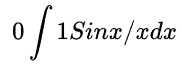
5
Connect with us on Discord to become a contributor.
10
Solve the following set of equations using Gauss Siedal method.
x + 2y + 3z = 4
6x + 4y + 5z = 16
5x + 2y + 3z = 12
5
Connect with us on Discord to become a contributor.
11
Solve the following differential equation for 0 ≤ x ≤ 1 taking h=0.5 using Runge Kutta 4th order method.
y'(x) + y = 3x with y(0)=2
5
Connect with us on Discord to become a contributor.
12
Solve the Poisson’s equation ∇2 f=3x2y over the square domain 0 ≤ x ≤ 3, 0 ≤ y ≤ 3 with f=0 on the boundary and h=1.
5
Connect with us on Discord to become a contributor.